
Jean Prouvé & LWD Architecture Workshop
(Lagneau, Weill & Dimitrijevic).
Standard Tropical Timber-Framed Housing.
This production model derives from Jean Prouvé’s 1958 steel-framed prototype.
The contract for six hundred and eighteen modules for teacher housing and school buildings was awarded to Atelier LWD in 1964, following an international competition funded by the European Fund.
The selected program demonstrates a successful synthesis of traditional and modern techniques.
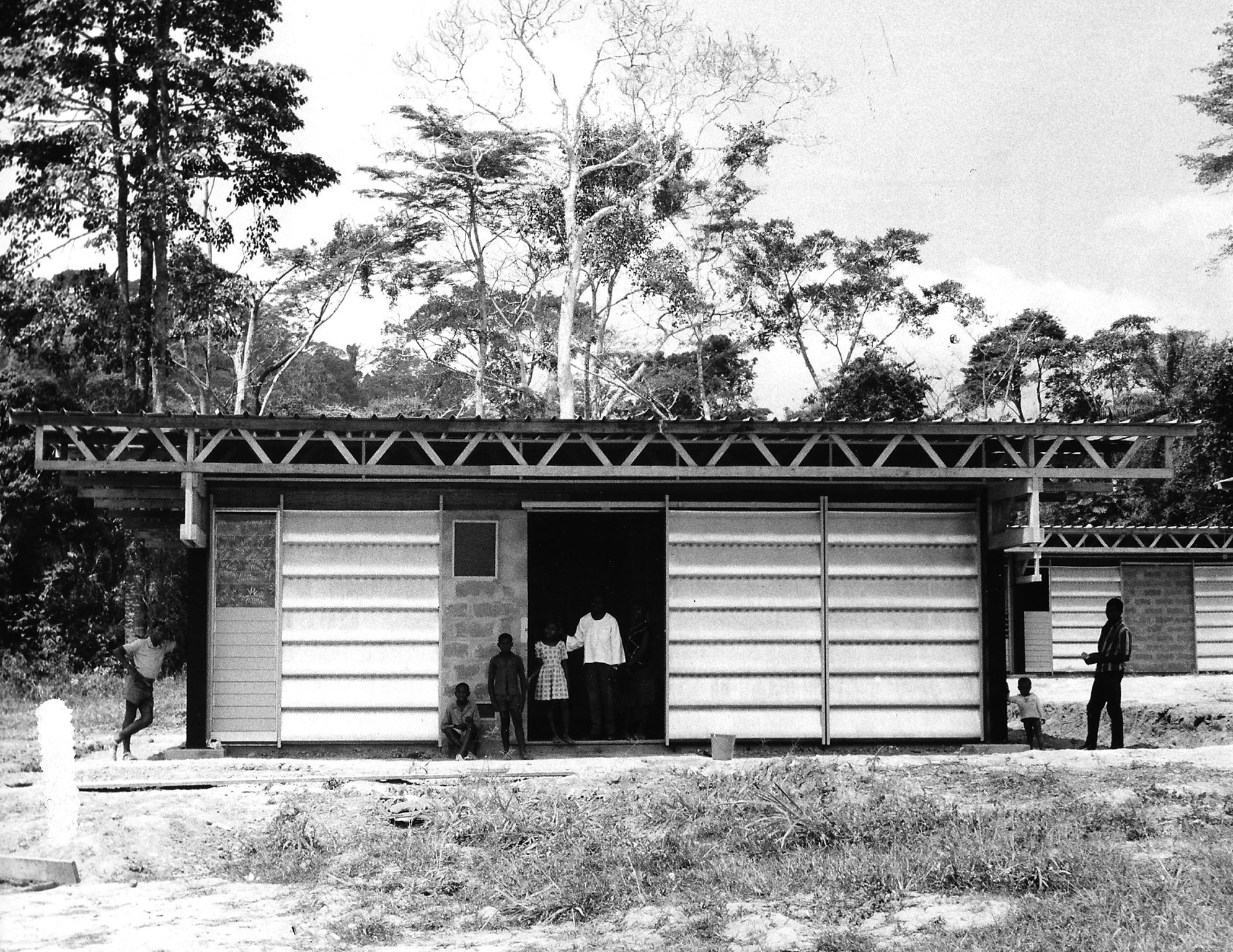
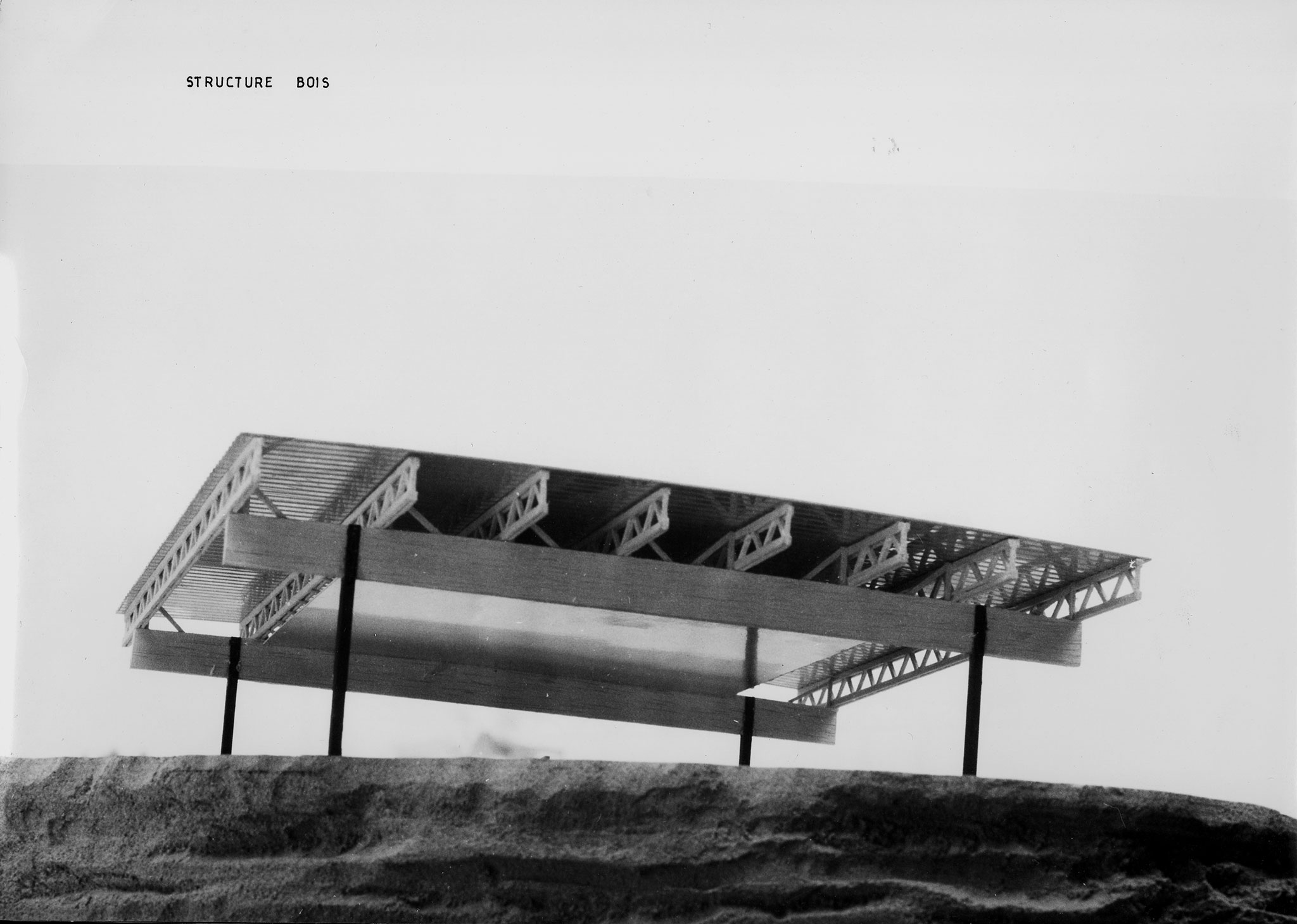
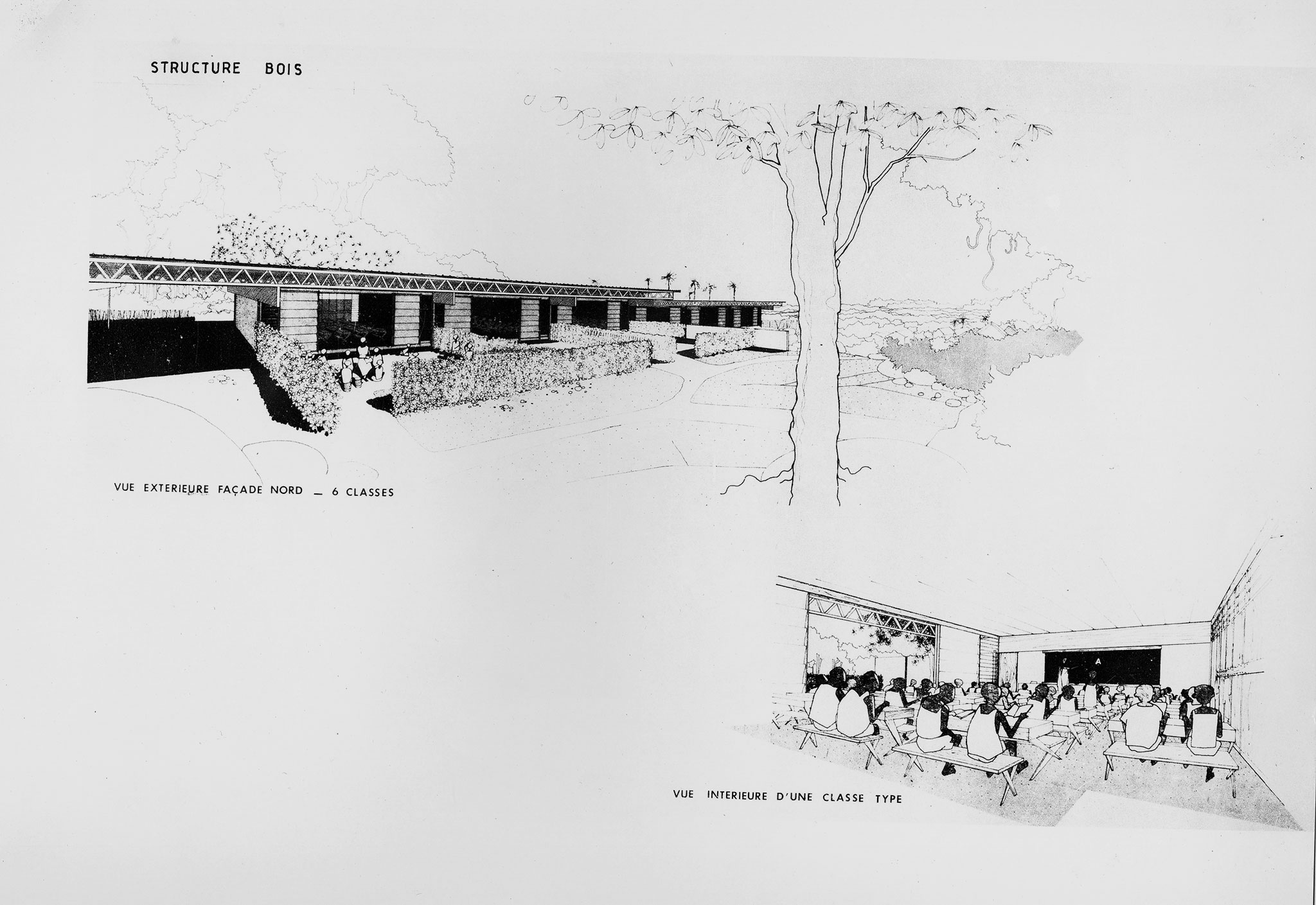
Designed with a modular principle of 8.75 x 8.75 m at the center distance of the load-bearing posts, the housing units consist of one or two modules, and the school buildings of one to six modules.
The result of the collaboration between Jean Prouvé, consulting engineer, and the Atelier d’architecture LWD (Lagneau, Weill & Dimitrijevic), this structure embodies the prospective research for an industrialized housing system for tropical countries, and particularly for equatorial Africa with its hot and humid climate.
Unlike Jean Prouvé’s Tropical Houses (1949-1950), the process studied here does not aim for complete industrialization of construction, but rather the mass production of a few standardized metal elements complemented by local materials, easily assembled by local labor.
These prefabricated elements include an aluminum roof tray and facade panel, manufactured in Cameroon by the Alucam factory in Édéa, a subsidiary of Péchiney-Aluminium Français, as well as a load-bearing post made of folded steel sheet of French manufacture.
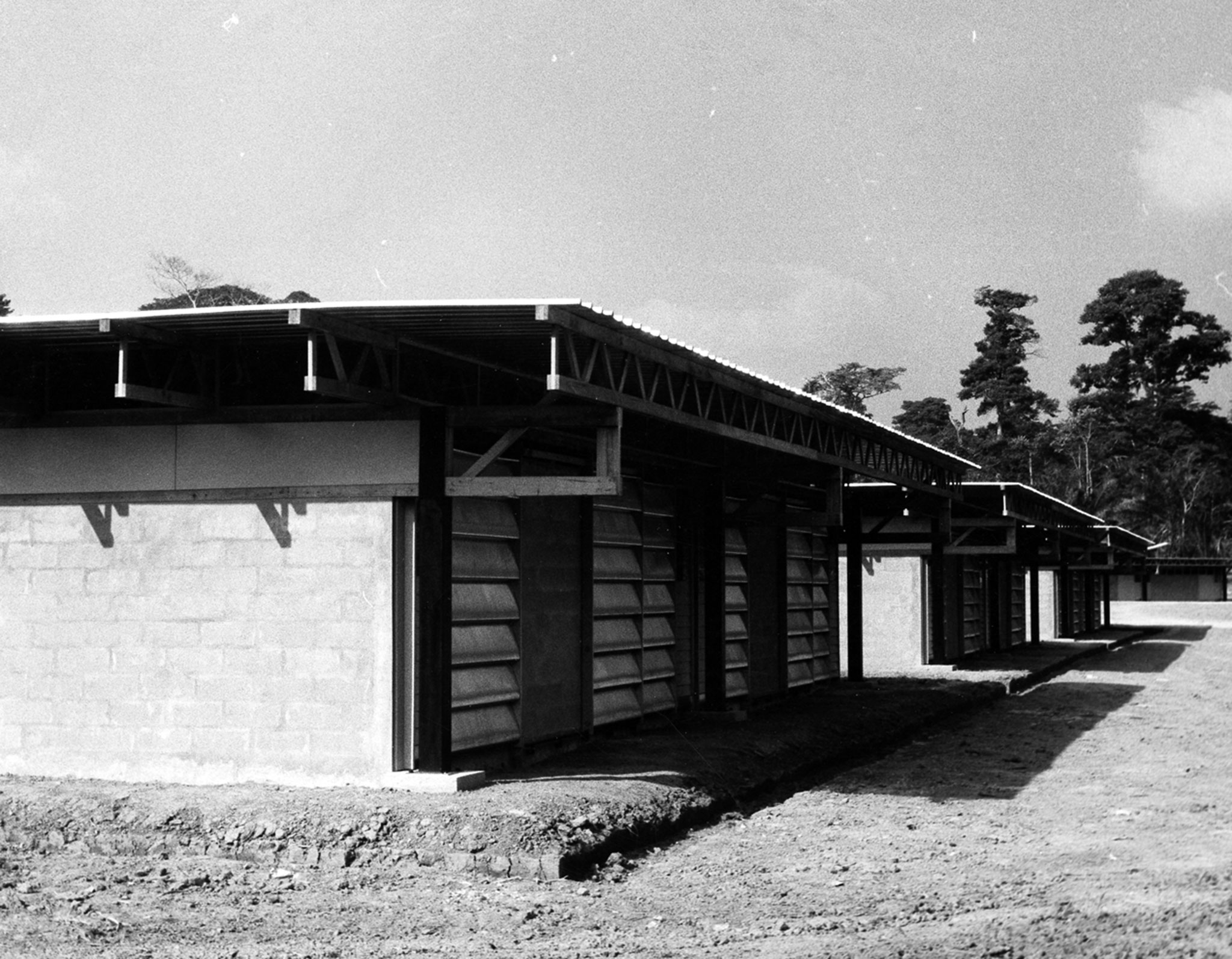
The concrete screed, the gable walls, and the facade wall sections (depending on the model, recommended in concrete blocks or wood cladding in forested areas), as well as the red wood framework, are produced by local labor.
The pursuit of economies through the valorization of Cameroon’s natural resources guided the architects towards the extensive use of wood in this production model, replacing Jean Prouvé’s 1958 steel framework prototype, which was far too expensive.
Most of these buildings have been destroyed or altered, their fragile aluminum facade panels replaced by concrete block walls.
The Timber Framework
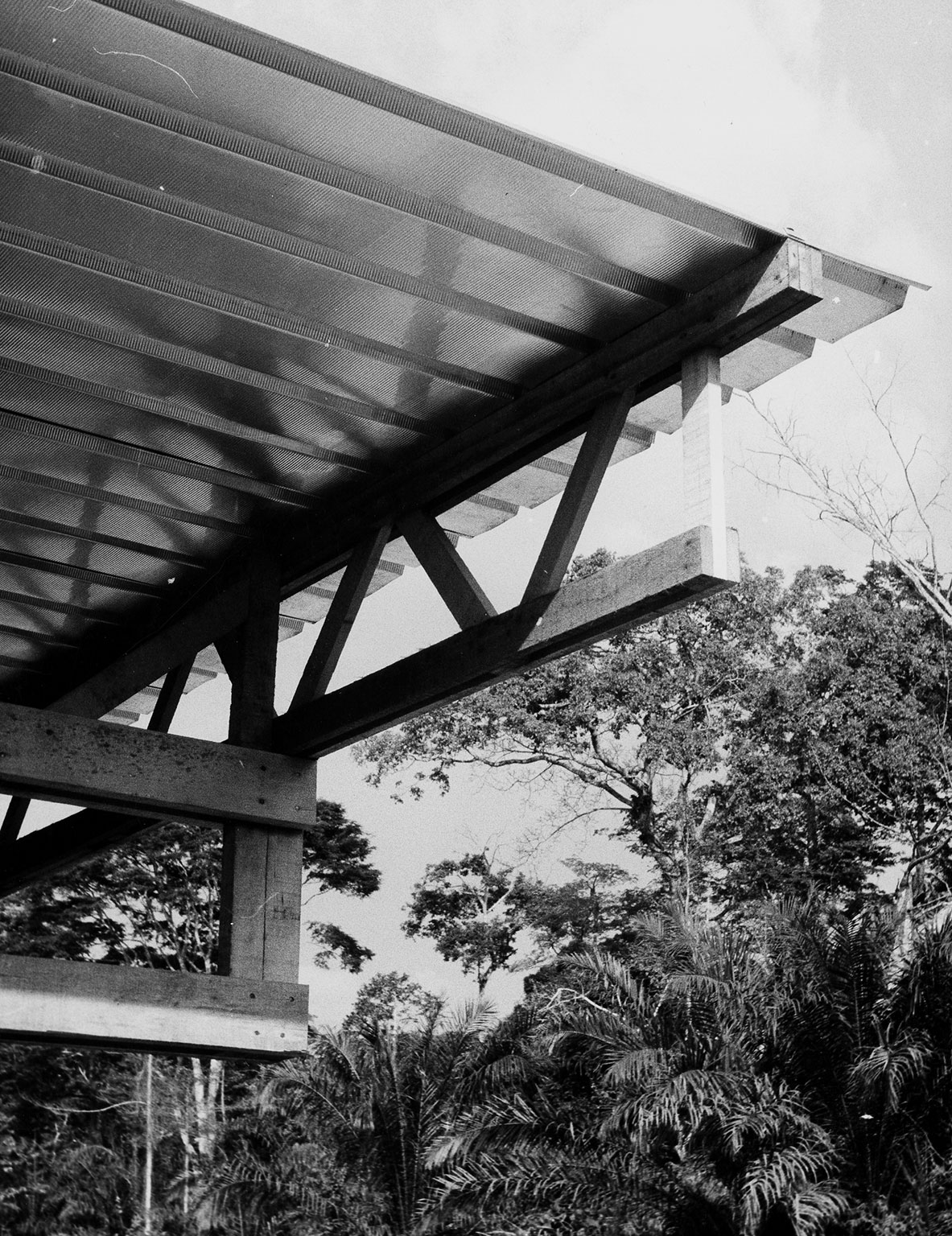
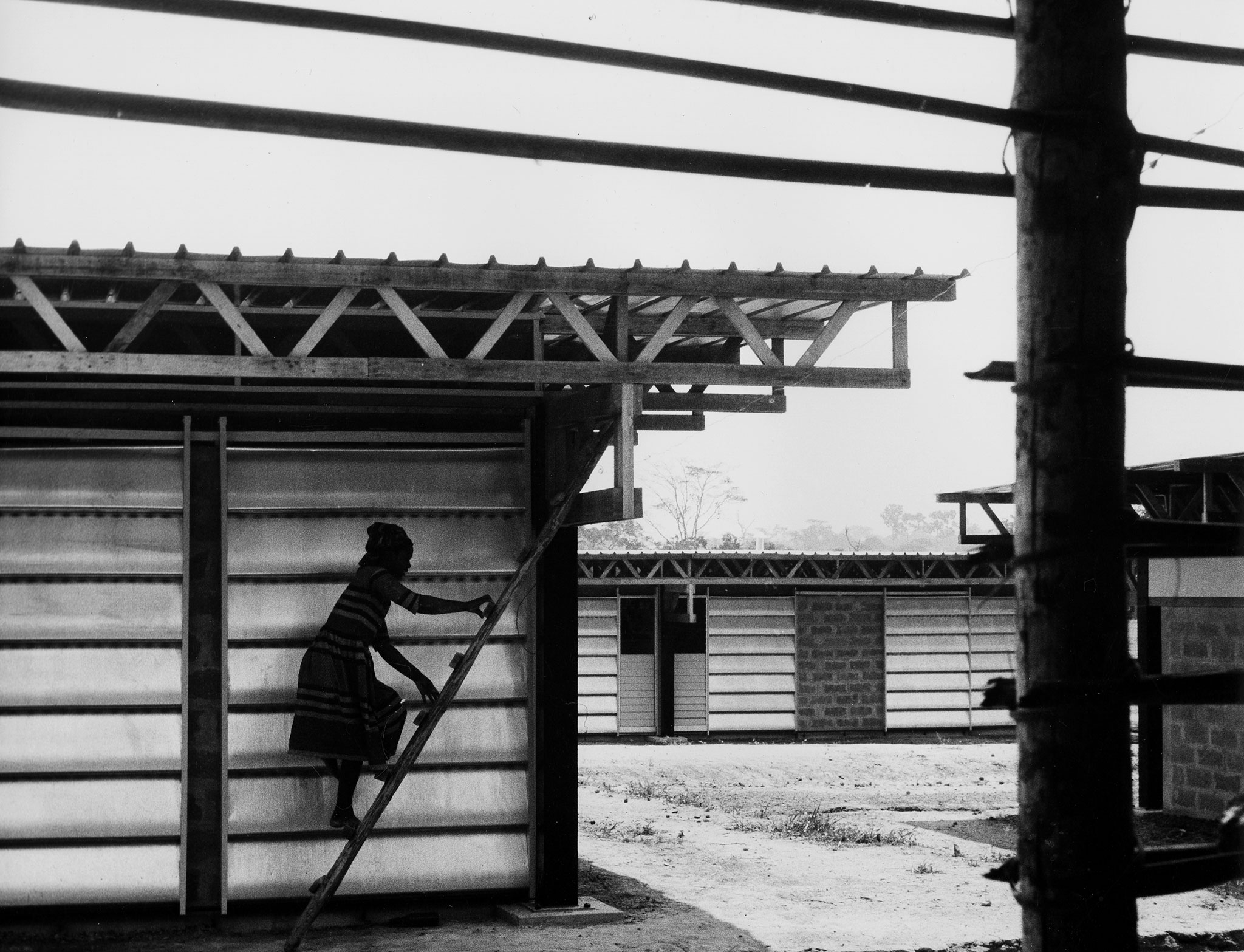
Four load-bearing posts, made of navy blue lacquered folded steel sheet and placed at the four corners, are shorter and of stronger section in the production model than in the prototype. The two lateral trusses of a robust red wood framework are fitted and bolted onto these posts, supporting the purlins to which the aluminum roof trays are fixed by hooks.
Purlins and lattice trusses are assembled with Japy screws and bolts on the first units built in the suburbs of the capital Yaoundé, later replaced by more economical nailing.
The Umbrella-Sunshade Roof
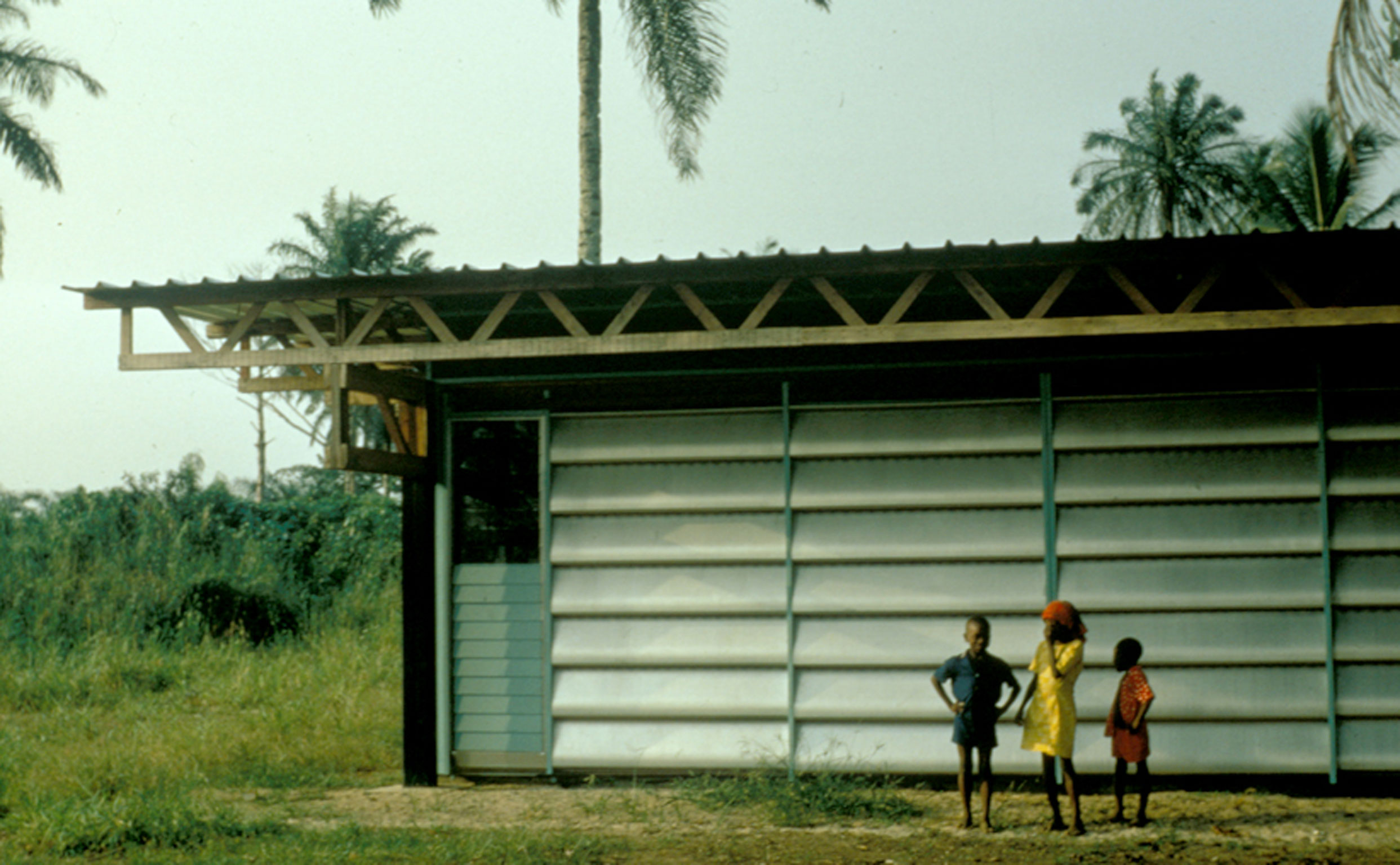
An aluminum tray roof, extending significantly beyond the living unit, forms an effective umbrella-sunshade against the effects of rain and sun.
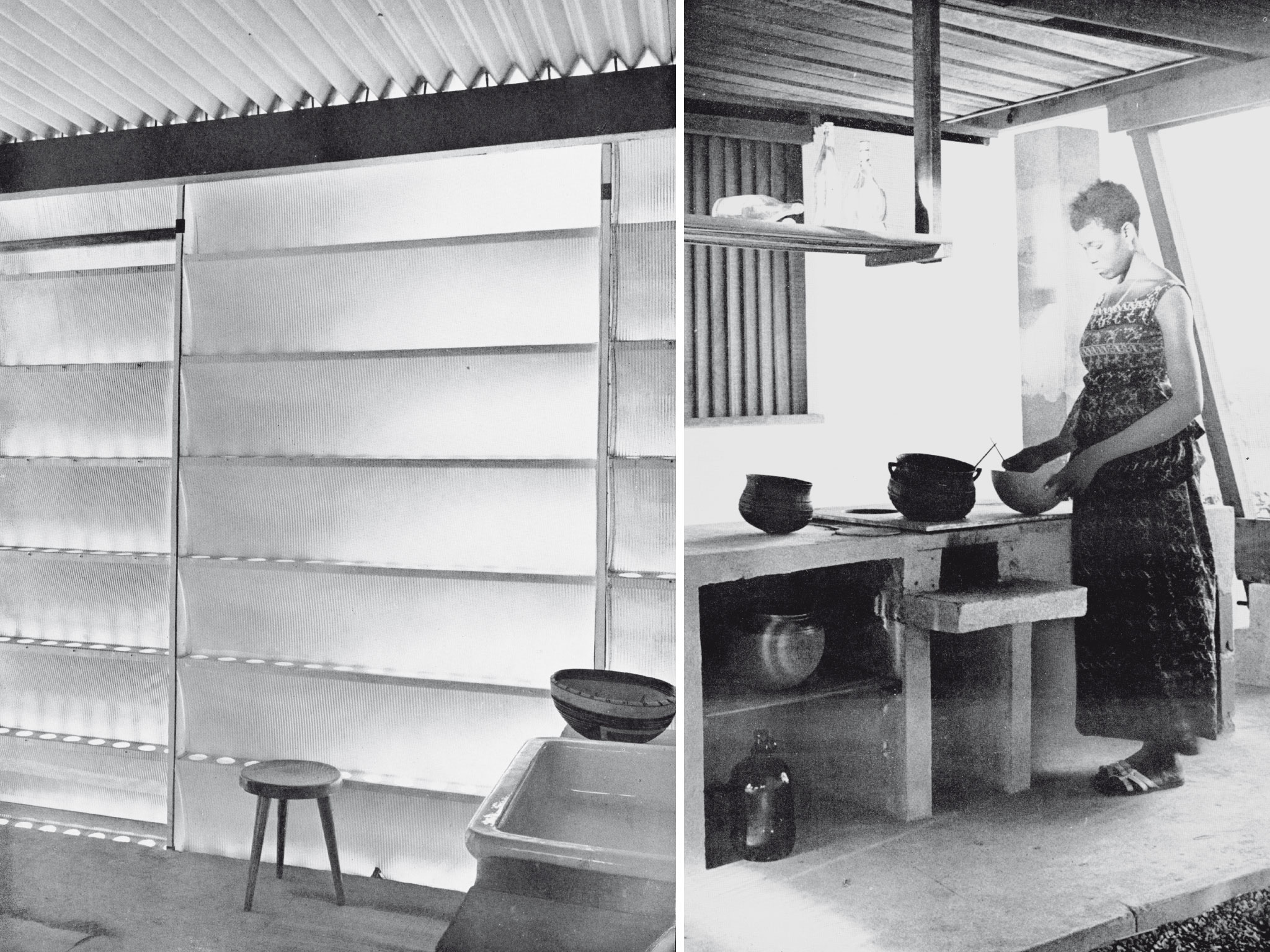
Thermal protection is provided by the permanent ventilation of the free space between the umbrella-sunshade and the false ceiling, and by the transverse ventilation from the perforated corrugated sheets and adjustable louver panels, known as “Nacos”.
The Corrugated Aluminum Facade Panels
This construction system offers great flexibility of use. Various facade arrangements exist, which, on a single module, can be identical or different.
The example presented on our site features two modules with identical facades, equipped with two movable panels serving as doors. These panels slide on a hardwood track at the top and are guided by a tubular rod at the bottom, framed by two fixed panels.
However, as with the prototype, some modules are equipped with a single sliding panel framed by two fixed panels and include one or two wall sections.
A panel consists of two sky-blue lacquered wooden side uprights, equipped with grooves into which the ends of seven large horizontal corrugated (eight corrugated on the prototype) ribbed aluminum sheets are fitted. These sheets were riveted together (as on the prototype) on the first units built, then interlocked on subsequent units.
These corrugated sheets, specially designed by Jean Prouvé, are perforated in the lower part to provide diffused lighting and ventilation.
Two sky-blue lacquered vertical panels, from the “Nacos” system with wooden slats and adjustable glass louvers, frame each of the two modules.
Bibliography
– ATEA, “Housing System in Humid Tropical Zone”, c. 1964.
– Joseph Abram “The Dream of the Real, from the Sahara House to the Schools of Cameroon” Faces, 1995.
– Joseph Abram, “Modern Architecture in France” Ed. Picard, 1999, pp. 264-265.
– “Jean Prouvé, the Poetics of the Technical Object”, Ed. Vitra, Weil am Rhein – 2004 pp. 222-223.
– Peter Suzer, Jean Prouvé Complete Works, volume 4, 2008, Ed. Birkhauser, pp. 180-181, 300.
– Eric Touchaleaume, Jean Prouvé / Atelier LWD, the SOFRA constructions, publication in 2015.
Available